
Table of Contents
Ask ten vendors what your first AI project should be and you’ll get ten answers, most of them shaped like a roadmap. Assess, strategise, pilot, scale. Eighteen months, six figures, and a steering committee.
That approach isn’t wrong, exactly. It’s just backwards for a company of your size. You don’t need to know where AI fits across the whole business before you find out whether it works in one corner of it. And the fastest way to find out is to pick a task that’s genuinely painful, fix that one thing, and let the result tell you what to do next.
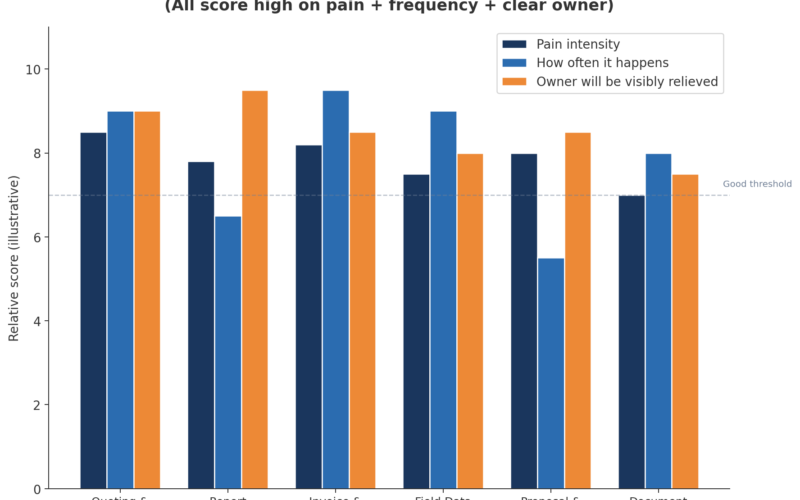
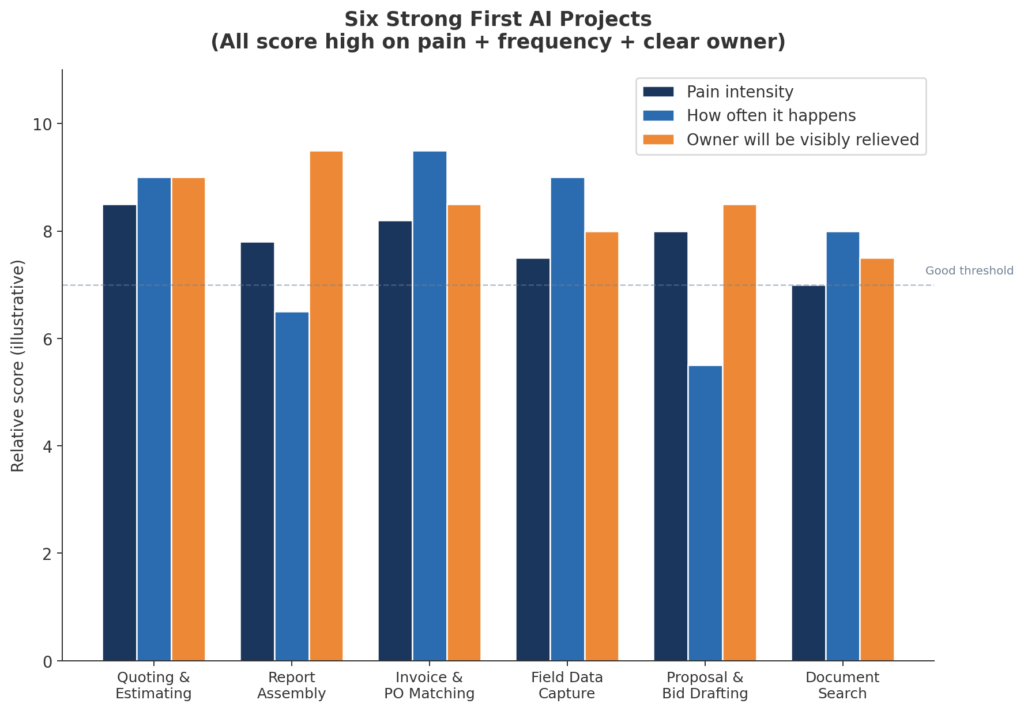
Six candidates come up again and again in oil and gas and manufacturing. They share three traits: the task is done manually today, it happens often enough that improvement is obvious, and the people doing it will tell you unprompted that it’s a problem. For each one below — what it looks like now, what changes, who feels it, and how you’d know it worked.
The six candidates for your first AI project
1. Quoting and estimating
Today: Someone experienced builds a number from memory, a spreadsheet of past jobs, and a call to the person who ran the last similar project. It’s accurate because of who’s doing it, not because of the process. When that person is on holiday, quotes wait.
What changes: Historical job costs, material pricing, and scope notes get pulled into one place and made searchable in plain language. The estimator asks what a comparable job actually cost, gets the relevant history back with sources, and builds the quote from evidence instead of recall.
Who feels it: Estimators and sales leads first. Then the owner, once quotes stop bottlenecking on one person’s calendar.
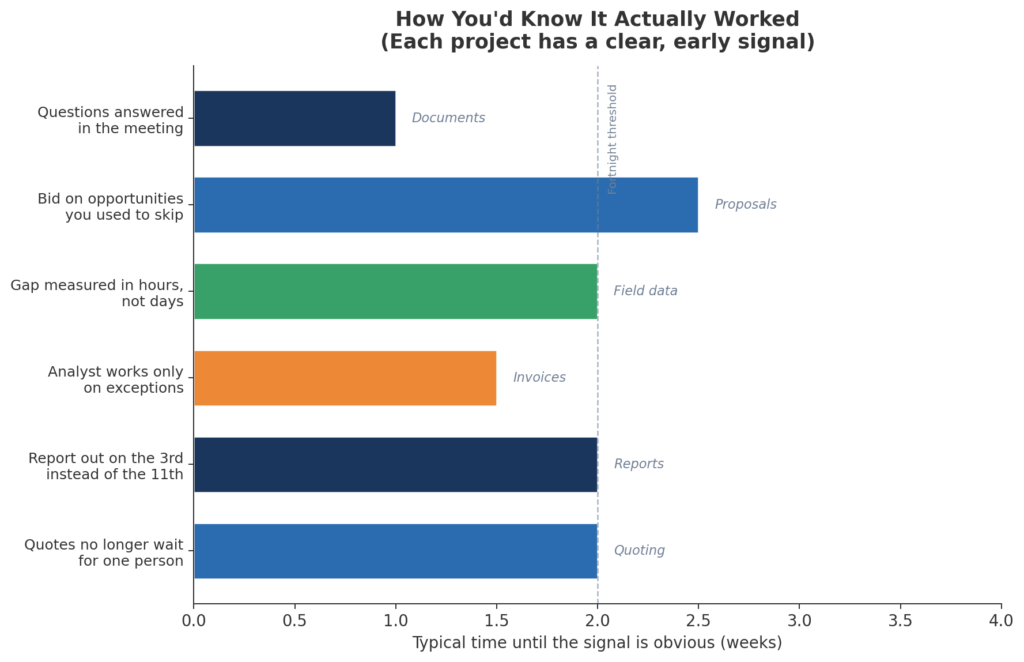
How you’d know it worked: Quotes go out without waiting for a specific individual to be available. Junior estimators produce numbers senior people are willing to sign. Arguments about pricing reference the same set of facts.
2. Report assembly
Today: The monthly or quarterly pack requires exports from three or four systems, manual reconciliation in Excel, and a narrative section written from scratch. One person owns it, it takes them several days, and it’s late often enough that everyone’s stopped commenting on it.
What changes: The data pull and reconciliation happen automatically. The draft narrative — production summaries, variance commentary, exception flags — gets generated from the numbers, then edited by the person who used to write it from nothing.
Who feels it: Whoever currently owns the pack, immediately and gratefully. Then the leadership team reading it, once it arrives early enough to act on.
How you’d know it worked: The report goes out on the third of the month instead of the eleventh. The person who owns it takes annual leave during reporting week without arranging cover.
3. Invoice and PO matching
Today: Three-way matching between purchase orders, delivery documentation, and invoices, done by hand across systems that don’t talk. Most of it is routine. The exceptions are what matter, and they’re buried in the routine.
What changes: Routine matches get processed automatically. Exceptions — quantity mismatches, unauthorised charges, duplicates — get surfaced with the supporting documents attached, so the analyst starts at the judgement call rather than the search.
Who feels it: Finance, obviously. But also procurement, who stop fielding “can you check this invoice” queries.
How you’d know it worked: Your finance analyst spends their week on the exceptions rather than finding them. Early payment discounts stop slipping. Duplicate payments get caught before they go out rather than in the annual audit.
4. Field data capture
Today: Tickets, readings, and inspection notes get written on paper or captured as phone photos, then re-typed into a system by someone in the office — often days later, sometimes with the original author no longer reachable to clarify what they meant.
What changes: Handwritten tickets and photos get read and structured at the point of capture. The data lands in the system the same day, with the original image attached for anyone who needs to verify it.
Who feels it: Field supervisors stop chasing paperwork. Back-office admin stops re-typing. Operations gets to see this week’s numbers this week.
How you’d know it worked: Nobody in the office is transcribing anything. The gap between work happening and work being visible in your systems is measured in hours rather than days.
5. Proposal and bid drafting
Today: Every submission requires rewriting the same safety record, capability statements, and technical approach sections — slightly reworded for each client, assembled by copying from whichever old proposal someone can find. The deadline pressure lands on senior technical staff who should be doing other things.
What changes: Your existing proposal library becomes a source you can draft from. First-pass sections come back written in your language, using your actual project history, tailored to the requirements of the specific bid. Your technical lead edits rather than writes.
Who feels it: Business development and the senior engineers who get pulled into bid weekends.
How you’d know it worked:
You bid on opportunities you’d previously have skipped for lack of capacity. First drafts arrive in hours. Senior technical staff review proposals instead of producing them.
6. Document search
Today: The contract clause, the spec sheet, the sign-off email — you know it exists. Finding it means searching a shared drive, three inboxes, and possibly a filing cabinet. Sometimes the answer is that nobody can find it, so a decision gets made without it.
What changes: You ask a question in plain English across every contract, report, and drawing you hold, and get the specific answer back with its source document attached. This is what our sister product, Nataero, was built for — and critically, it runs inside your environment, so confidential documents never leave your walls.
Who feels it: Legal, commercial, and compliance first. Then everyone, once people realise the answer is retrievable.
How you’d know it worked: Questions that used to take an afternoon get answered in a meeting. Decisions reference the actual contract language rather than someone’s recollection of it.
How to choose your first AI project
If more than one of these describes your business, the tiebreaker isn’t which is biggest. It’s which one has an owner who’ll be visibly relieved. Adoption is the failure point in most AI projects, and it’s much easier when the first user is someone who’s been complaining about the task for a year.
The second consideration is evidence. Choose something where you’ll know within a fortnight whether it worked — not something whose benefit shows up in next year’s numbers.
The third is scope you can describe in a sentence. If explaining the project takes a diagram, it’s a programme, not a first project. Save it.
How we de-risk going first
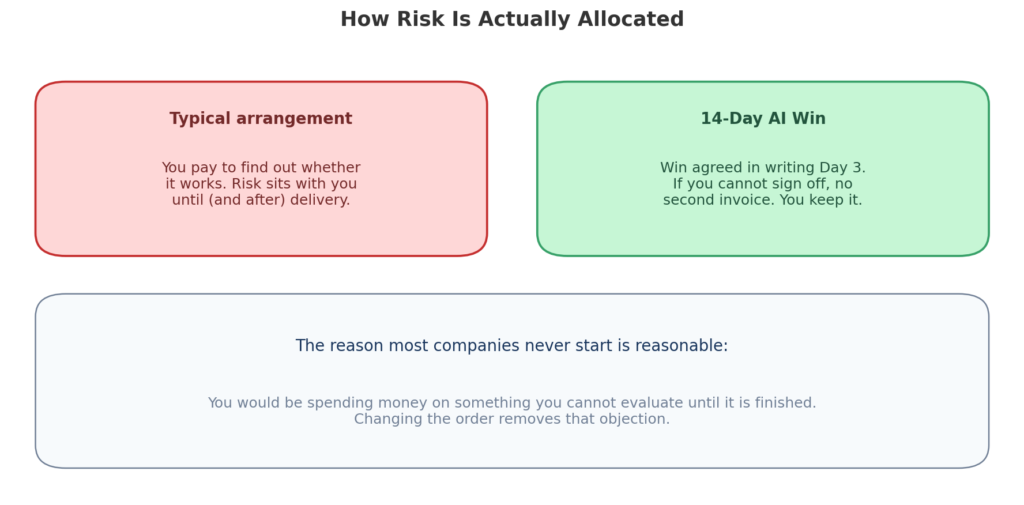
The reason most companies don’t start is reasonable: you’d be spending money on something you can’t evaluate until it’s finished.
So we changed the order. On Day 3 we agree in writing what the win is — what the thing does, who uses it, and what evidence means it worked. That document is the whole agreement, in plain English, before we build anything. We deliver by Day 14. If you look at it and can’t sign off against what we agreed, there’s no second invoice, and you keep everything we built: the solution, the code, the documentation, all of it. It’s yours either way.
That’s the 14-Day AI Win. Not a pilot programme, not a proof of concept that gets archived. One working thing, in your business, with a defined exit.
If you’d rather map the landscape before committing, our AI Launchpad assessment does that — and the assessment fee is credited back in full if you move forward. And if what you need is ongoing support or part-time AI leadership rather than a one-off build, our retainer and fractional CAIO arrangements cost a fraction of a full-time hire, with the option to pause or cancel at any time.
But most owners don’t need any of that yet. They need one project that works.
Frequently asked questions
What should my first AI project be?
Pick the task that is done manually today, happens weekly or more often, and has someone who visibly resents doing it. In mid-size operators and manufacturers that’s usually quoting, report assembly, invoice matching, field data capture, proposal drafting, or document search. Company-wide strategy work can wait until one project has proved the idea.
How long should a first AI project take?
Weeks, not quarters. If the scope can’t be delivered and evaluated inside a fortnight, it’s too big to be a first project — break off the part that can. Our 14-Day AI Win is built around exactly that constraint: agreed in writing on Day 3, delivered by Day 14.
Do we need to clean up our data first?
Usually not. Data-cleansing programmes are a common reason companies spend a year preparing and never start. A well-chosen first project works with the documents and systems you already have, and tends to reveal which data problems actually matter — rather than fixing everything on the assumption that it all does.
What happens if the project doesn’t work?
That risk should sit with your provider, not with you. Under our acceptance guarantee, if you can’t sign off against the win we agreed in writing, there’s no second invoice — and you keep everything built regardless.
Will this replace jobs?
Every project on this list targets work people already describe as a burden: re-typing tickets, hunting for files, reconciling invoices line by line. The realistic outcome is that experienced staff spend more time on the judgement calls only they can make.
Who should own the project internally?
The person who does the task today. Not IT, not a steering group. First projects succeed or fail on whether the daily user adopts them, which is much likelier when they helped define what a good outcome looks like.
Related Resources
Contact Us
Ready to name your first AI project? Tell us which of the six is your bottleneck and we’ll tell you honestly whether it’s a good place to start — or whether one of the other five would serve you better.
Find our website here
Office- 832-819-5744
