
Table of Contents
Why turnaround decides more orders than pricing does
Ask a shop owner how many deals they lost on quote turnaround last year and you’ll get a number. Probably an underestimate, but a number.
Ask how many RFQs they never quoted at all and the room goes quiet.
That’s the more expensive one, and almost nobody tracks it — which is why the case for AI quote automation usually gets made on the wrong grounds. Speed is the visible benefit. Capacity is the real one.
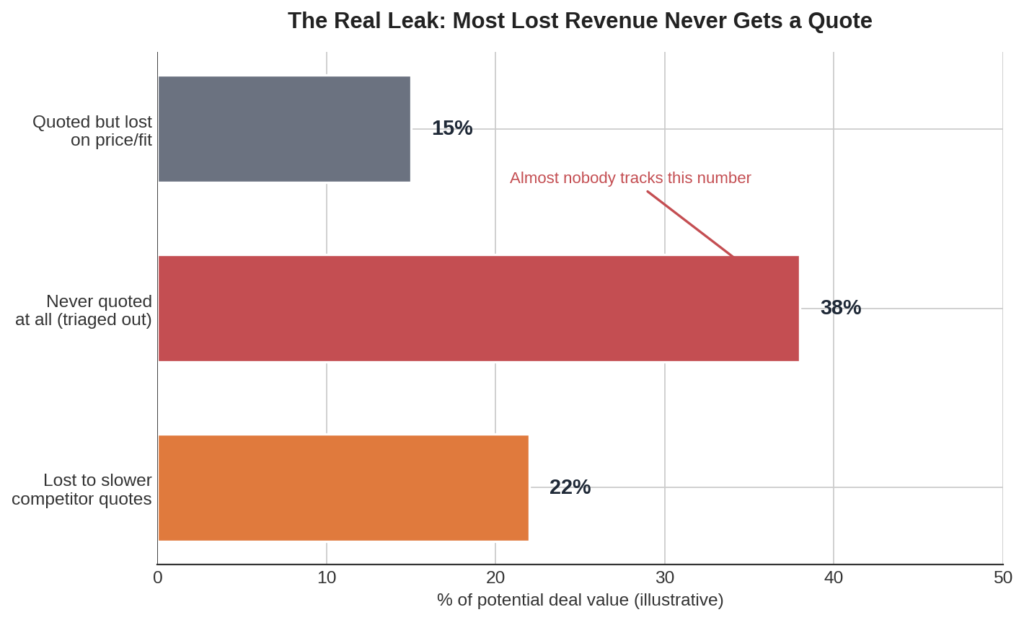
Every RFQ-heavy business triages. Most don’t admit it.
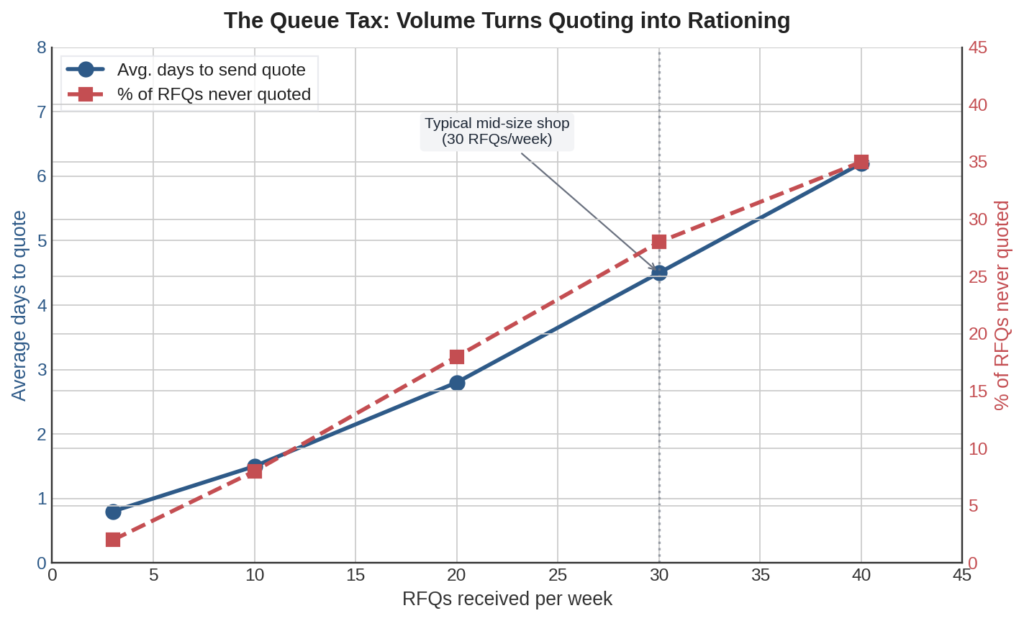
When the quoting queue is long, somebody makes a call about what’s worth the time. It’s rarely a formal decision. It’s an estimator looking at a stack on a Thursday afternoon and deciding which three of these seven are getting done today.
The ones that survive triage look familiar. Known customer, standard spec, similar to something quoted last quarter.
The ones that quietly die look like work. Unfamiliar company. Odd tolerances. A spec that would need someone to dig through old jobs to price properly.
Some of those were bad fits. Some were the start of a good account, and you’ll never know which.
The bottleneck isn’t pricing. It’s the queue.
Here’s what makes this frustrating: quoting isn’t hard. Your estimators are good at it. The pricing logic already exists — it’s in the rate sheet, in the past jobs, in their heads.
The problem is who does it.
In most mid-size manufacturers and distributors, the people who quote are the same people who solve production problems, field calls about live orders, and handle whatever broke that morning. Quotes are important but almost never urgent, so they lose every scheduling contest they enter.
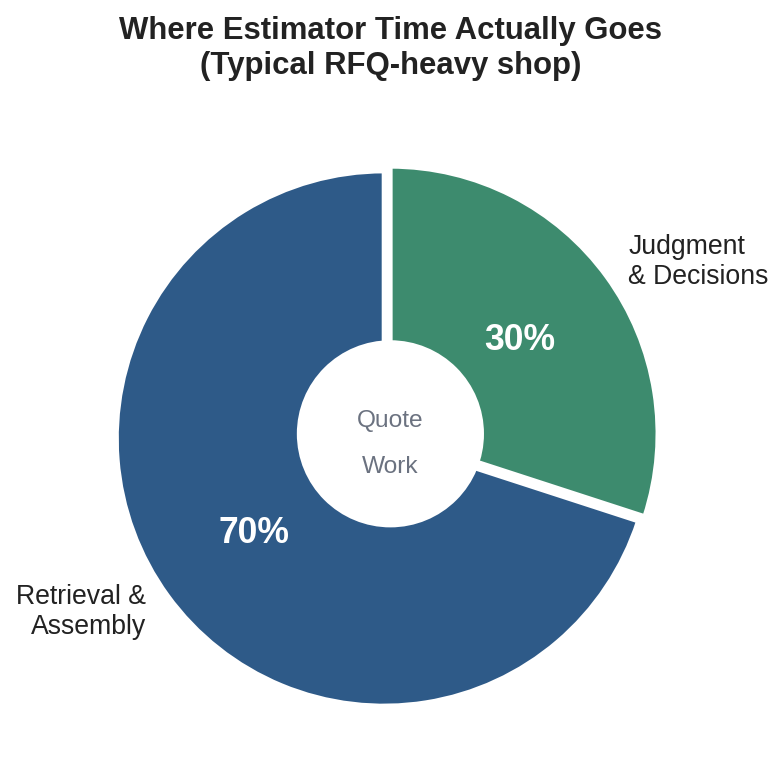
And the work itself splits into two very different halves:
Retrieval and assembly
- Reading the RFQ and establishing what’s actually being asked for
- Finding comparable jobs and what they were priced at
- Applying the rate sheet — correct tiers, terms, exceptions
- Drafting the document in your format with your terms
Judgment
- Whether this job is worth quoting aggressively
- What this particular customer will push back on
- Whether the last one like it ran long, and what that means for the number
Only the second half needs an experienced estimator. The first half is where the days go.
What a Quote-to-Order Agent actually does
It handles the first half.
The agent reads the inbound RFQ, prices it against your rate sheet, and drafts the quote. Your estimator opens a working draft rather than a blank document.
They still own every decision that matters. They check the assumptions, adjust for what the agent couldn’t know — the customer who always negotiates, the material your supplier just flagged, the job that ran long last time — and send it.
What changes is the starting point, not the judgment. The retrieval work that used to happen before an estimator could even think about the quote has already happened by the time they open it.
Where this matters most is volume. A shop quoting three RFQs a week doesn’t have a queue. A shop quoting thirty does — and the thirtieth one is always the one that waits, or doesn’t get quoted at all.
What changes when AI quote automation stops being rationed
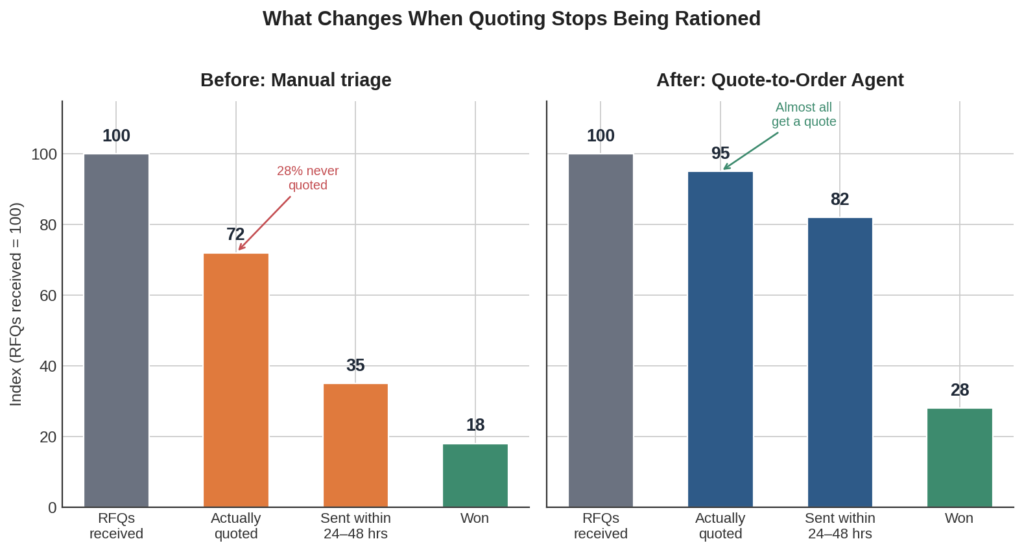
Two things, and the second is the one worth caring about.
The obvious one: quotes go out faster, and you stop losing work to whoever answered first.
The less obvious one: the triage stops. You quote the awkward ones. The unfamiliar customer, the odd spec, the job you’d have skipped in a busy week — those get priced, and you find out which of them were worth having instead of assuming they weren’t.
That’s a change in what your business is willing to pursue, not just how fast it responds.
Where this starts
Not with software. With a look at your actual process — how RFQs arrive, what your team does with them, where the queue forms, and how much of that work is genuinely judgment versus retrieval.
That’s the conversation we have before anything gets built. Sometimes it points to an agent. Sometimes it points to something simpler: a rate sheet that isn’t structured for reuse, or approval steps nobody can justify.
Either way, here’s the question worth putting to your own team this week:
How long does a quote take — from the moment it arrives to the moment it goes out? And how many never make it out at all?
The second number is usually the one that changes the conversation.
Related Resources to AI quote automation
Contact Us
Ready to look at your quoting process? Tell us roughly how many RFQs you handle a week and how long they currently take, and we’ll tell you honestly whether an agent is the right fix — or whether something simpler would get you further.
Find our website here
Office- 832-819-5744
