
Table of Contents
Somewhere in your organisation, this conversation has already happened.
Someone in operations spends four hours hunting through a document set for a single clause. Someone else says: just use ChatGPT. And the person who actually owns the risk — legal, compliance, the DPO, the security lead — says no. AI Fails for Confidential Documents.
They’re not being obstructive. They’re not behind the times. They’re responding to something structurally true about how most AI document tools work, and it’s worth naming precisely, because the usual framing of this argument is wrong.
The objection isn’t “AI is insecure”
Let’s clear this up first, because the lazy version of this argument gets repeated constantly and it doesn’t survive contact with a procurement team.
The major AI providers are not careless with data. Enterprise tiers from OpenAI, Anthropic, Microsoft and Google offer zero data retention options, contractual commitments not to train on customer inputs, SOC 2 attestation, regional data residency, and in some cases deployment inside your own cloud tenant. Anyone claiming these are reckless products is selling something.
So if the security posture is genuinely strong, why does the answer keep coming back as no?
Because the question compliance is asking isn’t “is this provider trustworthy?” It’s a different question entirely.
AI Fails for Confidential Documents- Contractual guarantees vs. architectural guarantees
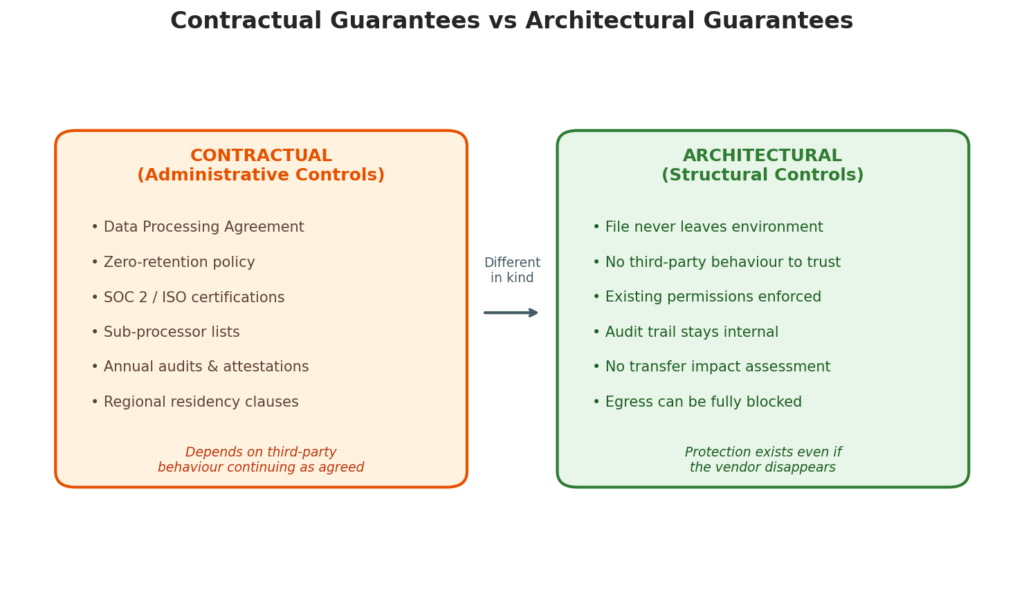
Here is the actual distinction, and it’s the one that matters.
When you upload a document to a hosted AI service, the file leaves your environment. What protects it from that point onward is a promise: a data processing agreement, a retention policy, a certification, an audit report. These are real, enforceable and meaningful. They are also, in the strict sense, administrative controls — protection that depends on a third party continuing to behave as agreed.
An architectural guarantee is different in kind. If the file never leaves your environment, there is no third-party behaviour to depend on. There is no retention policy to verify, no sub-processor list to review annually, no transfer to assess, no incident at a vendor that becomes an incident of yours.
For most business documents, an administrative control is entirely proportionate. For regulated documents, it often isn’t — and not because the vendor is untrustworthy, but because the compliance framework doesn’t accept trust as a control at all.
Where “just upload it” actually breaks
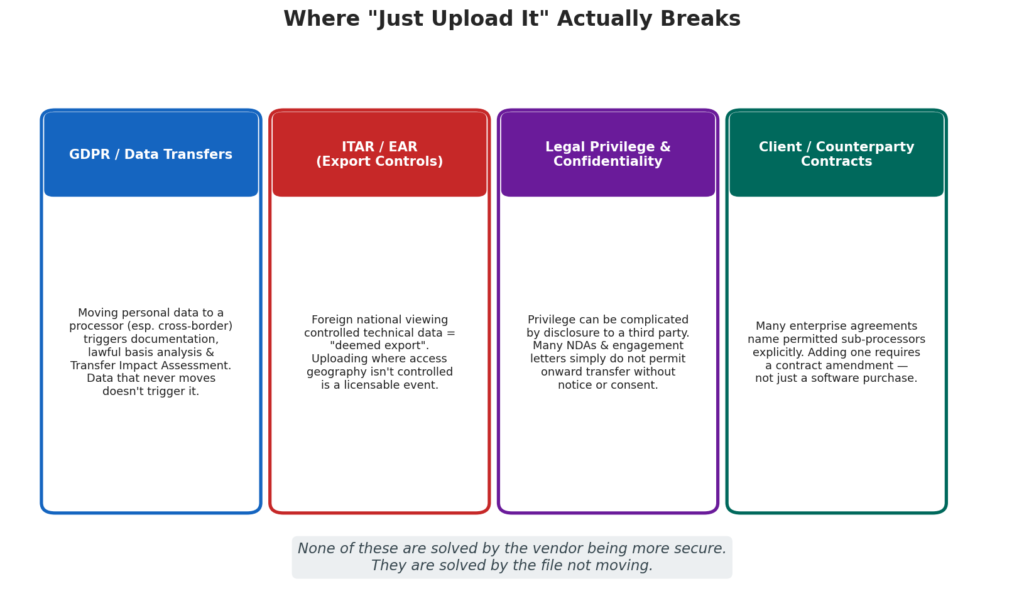
The failure isn’t hypothetical or philosophical. It shows up in specific, mundane places:
Data transfer assessments. Under GDPR, moving personal data to a processor — particularly across borders — triggers documentation, lawful basis analysis and often a transfer impact assessment. Every new tool means repeating that work. Data that never moves doesn’t trigger it.
Export-controlled technical data. Under ITAR and EAR, a foreign national viewing controlled technical data is a “deemed export” — a licensable event. Uploading that data to infrastructure where access geography isn’t something you control directly is a serious question, not a paperwork exercise.
Legal privilege and confidentiality undertakings. Privilege can be complicated by disclosure to a third party. Many client engagement letters, NDAs and data-sharing agreements simply do not permit onward transfer to a processor without notice or consent — regardless of that processor’s security posture.
Client and counterparty contracts. Plenty of enterprise agreements name their permitted sub-processors explicitly. Adding one means a contract amendment, not a software purchase.
Notice that none of these are solved by the vendor being more secure. They’re solved by the file not moving. That’s the whole point.
What “zero-upload” actually means
The alternative approach inverts the standard architecture. Instead of moving documents to the model, the model operates where the documents already live — inside your environment, behind your existing access controls.
In practice, that means:
- Documents stay in place. No copy is made, no index is shipped out, no file is transmitted to an external service.
- Your existing permissions still apply. If someone can’t open a folder today, an AI layer shouldn’t quietly grant them a summary of its contents. Access control that doesn’t survive the AI layer isn’t access control.
- The audit trail stays yours. Queries, retrievals and outputs are logged in your environment, in a form your auditors can actually inspect.
- The compliance question changes shape. It stops being “can we approve this transfer?” and becomes “can we approve this internal tool?” — a materially easier question, asked of a materially smaller surface.
This isn’t a claim that hosted AI is bad. It’s a claim that for a specific class of document, the transfer itself is the blocker, and no amount of vendor assurance removes it.
AI Fails for Confidential Documents- What to actually do about it
If you’re the person stuck between a team that wants the productivity and a risk owner who keeps saying no, here’s a practical sequence.
1. Sort your documents by transfer restriction
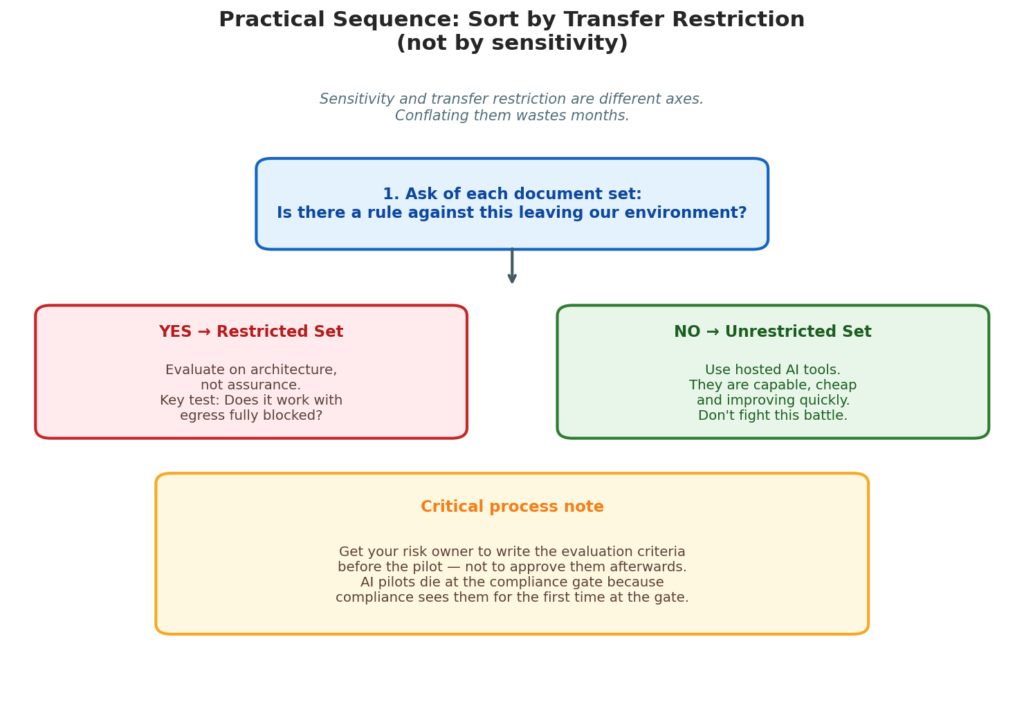
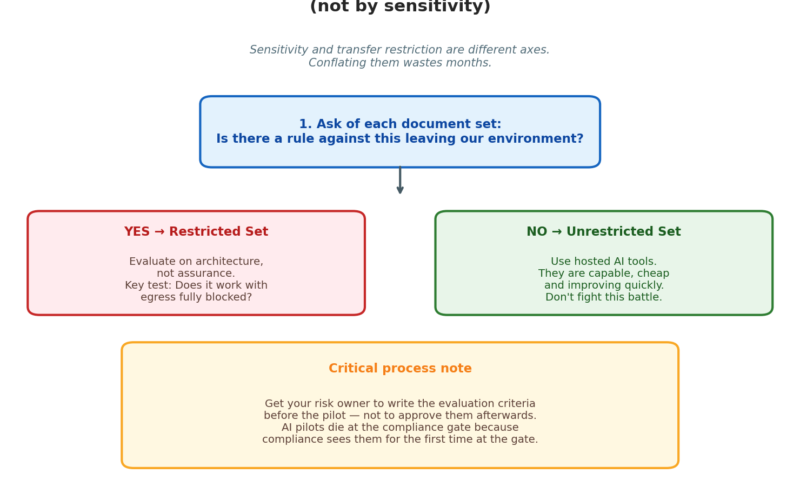
These are different axes and conflating them wastes months. Plenty of highly sensitive material can be lawfully processed by an approved processor. Plenty of unremarkable material can’t leave a jurisdiction. Ask of each set: is there a rule against this leaving our environment? That question sorts your estate faster than a sensitivity classification exercise.
2. Let the unrestricted set use hosted tools.
Genuinely. If the transfer is lawful and contractually permitted, hosted AI is capable, cheap and improving quickly. Fighting that battle is a poor use of political capital.
3. For the restricted set, evaluate on architecture rather than assurance.
The questions worth asking a vendor: Where does the document sit during processing? Where does the index live? What leaves the environment, if anything — including telemetry and diagnostics? Are existing permissions enforced at retrieval time, or applied afterwards? Can we run this with egress blocked entirely?
That last one is the clarifying question. A tool that genuinely works in-environment will keep working with outbound network access switched off. A tool that doesn’t, won’t. It’s a five-minute test that cuts through an entire sales cycle.
4. Get your risk owner to write the evaluation criteria.
Not to approve them afterwards. The reason AI pilots die at the compliance gate is that compliance sees them for the first time at the gate.
The short version
“Just use ChatGPT” isn’t wrong because ChatGPT is unsafe. It’s wrong because for regulated documents, the upload is the regulated event — and a tool that requires it has already failed the test before anyone evaluates its answers.
The useful question isn’t how much do we trust this provider? It’s what would we need to trust, and can we design that requirement away entirely?
FAQ
Is it safe to upload confidential documents to ChatGPT? For many business documents, enterprise tiers with zero data retention are a reasonable control. The harder question is whether the transfer itself is permitted — under GDPR, export control, privilege obligations or client contracts. That’s a governance question, and it’s independent of how secure the provider is.
What does zero-upload AI mean? It describes an architecture where documents are processed inside your own environment rather than transmitted to an external service. The model operates where the files already sit, so no copy leaves your infrastructure and no external transfer occurs.
Can AI document search work without sending data to the cloud? Yes. In-environment deployments run retrieval and generation within your existing infrastructure and permission model. A reliable test: ask whether the system still functions with outbound network access blocked.
How is this different from an enterprise ChatGPT plan? Enterprise plans protect your data with contractual and policy commitments after it arrives. In-environment deployment removes the arrival. Both are legitimate; they answer different compliance questions.
Contact Us
CDO Advisors provides in-environment document search for organisations that can’t move their files.
No uploads, no external index, no exceptions.
Find our website here
Office- 832-819-5744
