
Table of Contents
You don’t have an AI problem. You have a time problem. A quick AI readiness check will show you where that time is going.
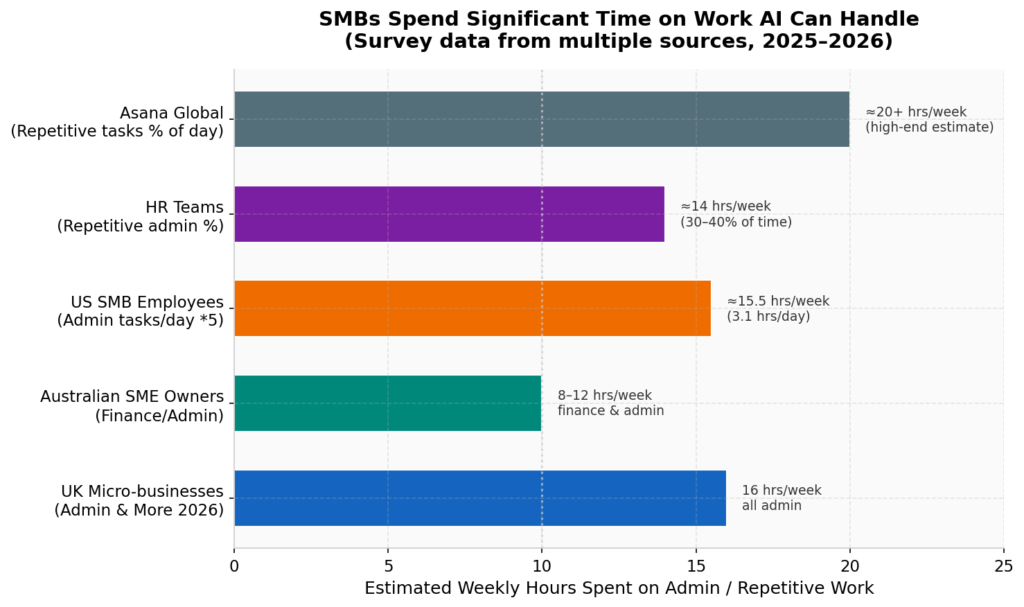
Somewhere in your business, a capable person is spending hours each week on work that doesn’t need their brain: retyping, re-answering, re-writing. That’s where AI pays off first. Not in a grand strategy or an expensive platform, but in one small, boring task that quietly disappears.
The hard part is spotting it. So here’s a quick check. Seven signs, one point each. Keep count as you read.
1. The same task lands on someone’s desk every week
What it looks like: a bookkeeper who compiles the same cash-flow summary every Monday, or an office manager who builds the weekly rota by hand.
Score a point if you can name a recurring task that takes over an hour a week and follows roughly the same steps each time.
Why it’s an easy win: predictable inputs and predictable outputs are exactly what AI handles well. The job shifts from doing the task to checking it.
2. Your customers keep asking the same questions
What it looks like: a dental practice fielding “do you take NHS patients?” five times a day, or an online shop answering “where’s my order?” on repeat.
Score a point if you could list your top ten customer questions from memory without checking.
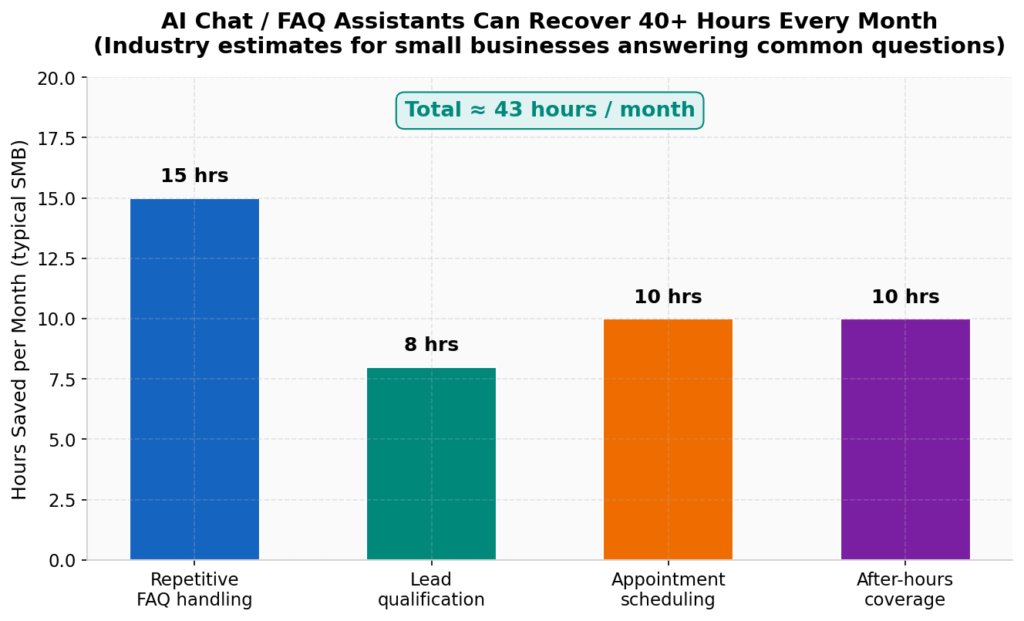
Why it’s an easy win: an AI assistant built on your own FAQs and policies can answer instantly or draft replies for your team to approve, so people only step in when it matters.
3. Critical knowledge lives in one person’s head
What it looks like: the operations lead who’s the only one who knows which supplier to call when stock runs short, or how to price an awkward job.
Score a point if someone’s holiday makes the rest of the team nervous.
Why it’s an easy win: AI can turn scattered emails, notes, and documents into a searchable guide your whole team can ask questions of. Less risk, fewer interruptions, faster onboarding.
4. You’re collecting data you never read
What it looks like: a restaurant with 400 Google reviews nobody has properly analysed, or a CRM full of call notes that never get revisited.
Score a point if you have information you know is valuable but haven’t looked at properly in months.
Why it’s an easy win: AI can read hundreds of reviews, tickets, or survey answers and surface the top complaints, trends, and opportunities in minutes.
5. Writing is quietly eating your week
What it looks like: a builder who spends Sunday evenings writing quotes, or a founder who keeps putting off the job advert, the newsletter, and the website copy.
Score a point if you regularly delay writing something because you don’t have time to do it well.
Why it’s an easy win: AI is an excellent first-draft partner. Give it your notes and a past example, and you’ll spend ten minutes editing instead of an hour starting from scratch.
6. Your team is the glue between your tools
What it looks like: an enquiry comes in by email, gets typed into a spreadsheet, copied into the booking system, then confirmed by hand.
Score a point if someone regularly copies information from one system into another.
Why it’s an easy win: AI paired with simple automation can pull the details out of an email or form, tidy them, and send them where they belong. Fewer typos, faster responses.
7. Someone’s already experimenting
This one’s about people, not processes, and it might be the most important sign of all.
What it looks like: a team member who drafts emails with ChatGPT or Claude, sends round AI articles, or keeps asking “could we automate this?”
Score a point if anyone on your team, including you, is already trying AI tools, even informally.
Why it’s an easy win: tools are easy to buy; curiosity isn’t. Give that person one specific problem from this list and a few hours to solve it, and you’ve got your first pilot.
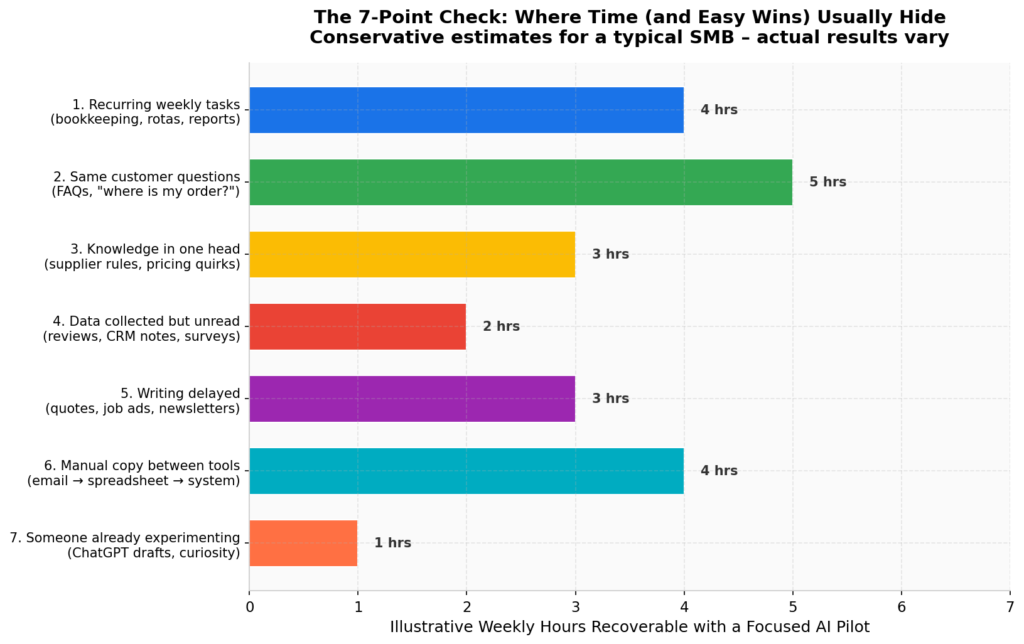
Your score
0–2: Not yet, and that’s fine. AI isn’t your biggest lever right now. Revisit this check in six months, especially signs 1 and 5, which usually appear first as you grow.
3–5: You’ve got a clear easy win. Pick the sign that costs you the most hours each week and run a small, focused pilot on it this month.
6–7: You’re leaving real time on the table. You have repetitive work, untapped information, and people ready to try new things. Start with the lowest-risk sign on your list, prove the result, then move to the next.
How to pick your first win
If you scored three or more, resist the urge to tackle everything. The best first project is frequent (it happens daily or weekly), low-risk (mistakes are easy to spot and fix), and measurable (you can tell how much time it saved).
Run it for two to four weeks. Count the hours saved. Then let that number make the case for what comes next.
Quick scorecard (save this)
- A recurring task takes over an hour a week
- Customers ask the same questions repeatedly
- Key knowledge sits with one person
- You have data you never analyse
- Writing tasks keep getting delayed
- People copy information between systems
- Someone’s already experimenting with AI
So, how many did you hit? Tell us your score in the comments, along with the one sign that made you wince. We’ll reply with a suggestion for where to start.
Ready to find your easy win?
If you scored three or more, we’d love to help you turn that into real time saved. We work with small and medium-sized businesses to spot the right first AI project, set it up, and make sure it actually sticks, without the jargon or the big-budget price tag.
Book a free 20-minute AI readiness call and we’ll go through your score together, pinpoint your best starting point, and give you a clear next step, whether or not you decide to work with us.
Book your free call: https://www.cdoadvisors.com/contact-us/
Email: sales@cdoadvisors.com
Phone: +1 (832)819-5744
