
Table of Contents
Four of these eight answers are some version of “you probably don’t need us.”
That’s not modesty. It’s that most of what gets sold as AI for operators is aimed at problems the buyer never defined, and the fastest way to waste a year is to skip the part where you work out whether you have one.
We spent this summer asking operations and engineering leaders across Texas oil, gas, and manufacturing what’s actually slow. The questions they asked back were better than ours. Here they are, answered plainly.
1. Is this just going to replace people?
Not in the work we do — and it’s the right question to lead with.
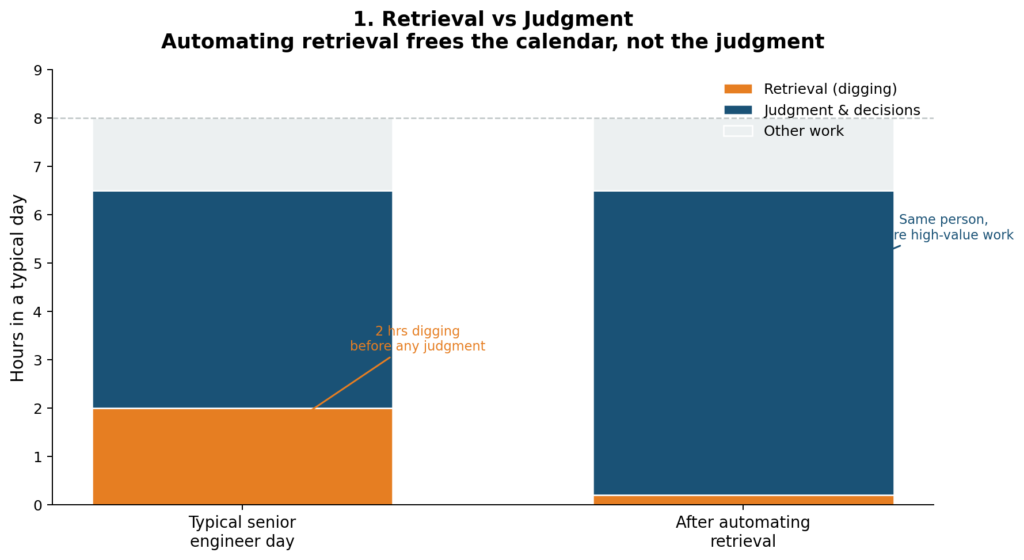
The distinction that holds up is retrieval versus judgment. Finding the record, pulling the comparable job, assembling the numbers from three systems: retrieval. Deciding what it means, what to quote, whether the anomaly matters: judgment.
Automating retrieval doesn’t remove judgment. It removes the two hours of digging that happen before anyone gets to exercise any.
Where it does change headcount is where a role was entirely retrieval. That exists, and pretending otherwise would be dishonest. But at most operators we talk to, the person doing the digging is a senior engineer who’d rather be doing something else — and the constraint isn’t their salary, it’s their calendar.
2. We already built reports on our accounting system. Isn’t that the same thing?
No, and if you’ve done that you’re ahead of most operators your size.
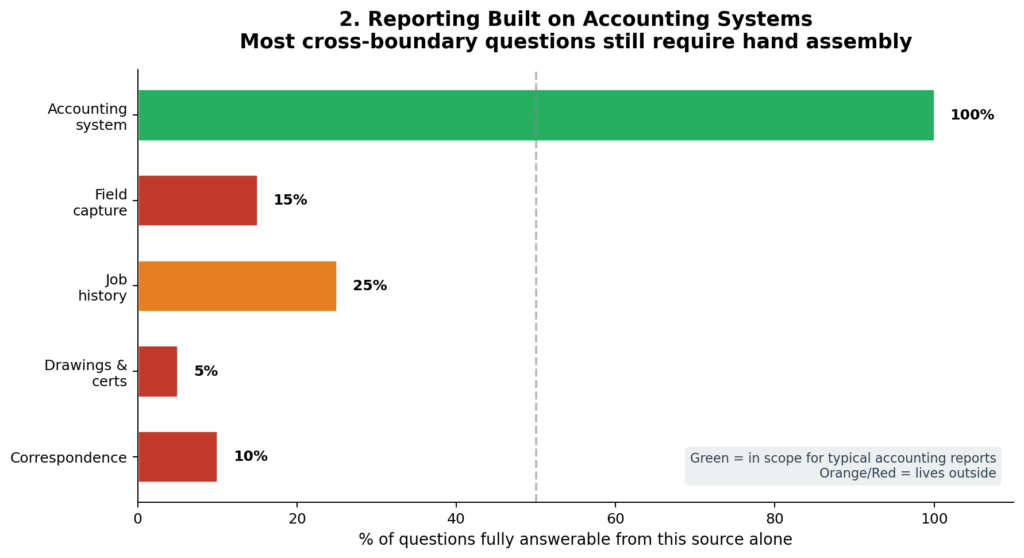
The limit is scope. Reporting built on an accounting system answers what the accounting system knows. Anything living outside it — field capture, job history, drawings, certifications, correspondence — isn’t in scope, so a question spanning finance and operations can only be half-answered before somebody starts assembling by hand.
The test is straightforward: think about the last five questions someone asked you that took more than an hour to answer. If all five were finance questions, you may genuinely be done. Most operators find two or three of them crossed a boundary their reporting doesn’t.
3. Our data is a mess. Doesn’t that disqualify us?
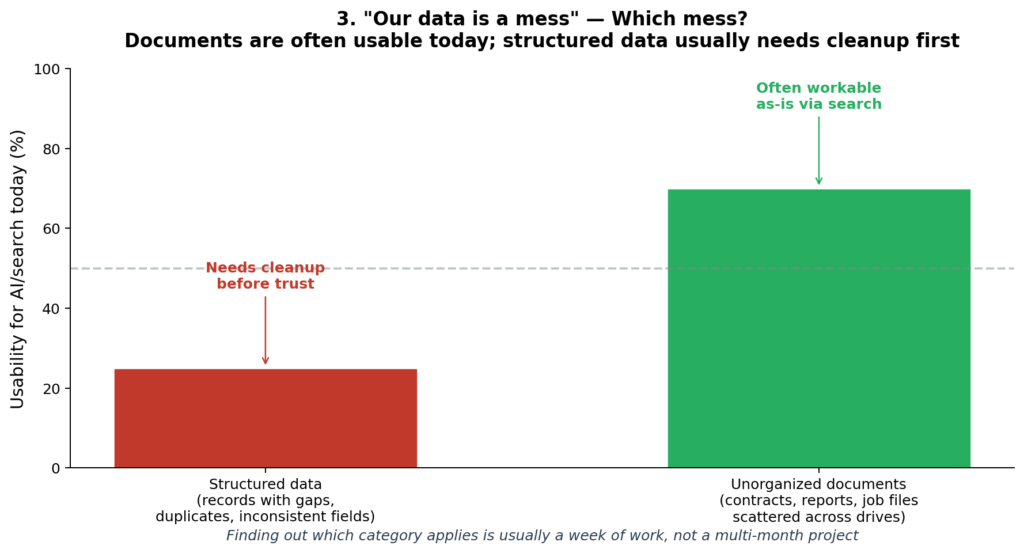
No, but it changes what’s realistic first — and the distinction most people miss is which mess.
Structured data that’s inconsistent — records in a system with gaps, duplicates, and fields nobody filled in the same way — generally needs cleanup before anything built on it is trustworthy.
Documents that were never organised — contracts, reports, inspection records, job files scattered across drives and inboxes — are often workable as they are, because searching documents doesn’t require them to be tidy first.
Most operators assume they have to fix everything before starting. Usually one category is fine to work with today and the other isn’t, and finding out which is a week of work, not a project.
4. How is this different from the search we already have?
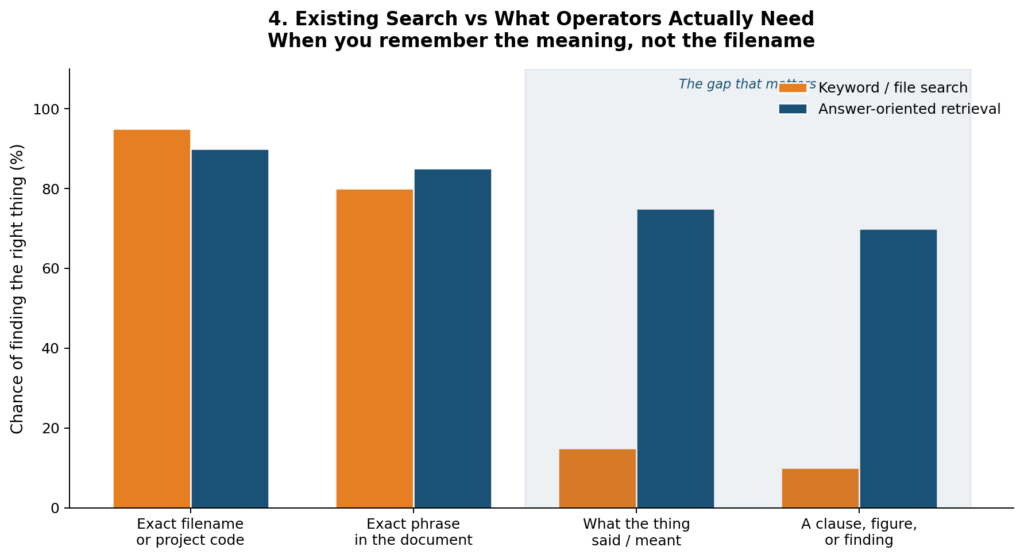
Your search finds files. The question is whether you needed a file or an answer.
If you remember the file name, the project code, or the exact phrase, existing search does the job and you don’t need anything else. That’s a real answer, not a hedge — plenty of businesses are fine here.
Where it breaks is when what you remember is what the thing said. There was a clause about liability caps. Someone quoted a figure for phase three. A report covered the findings from that year. None of that is a filename, and no amount of better keyword search turns it into one.
5. Our history is all documented. Isn’t that enough?
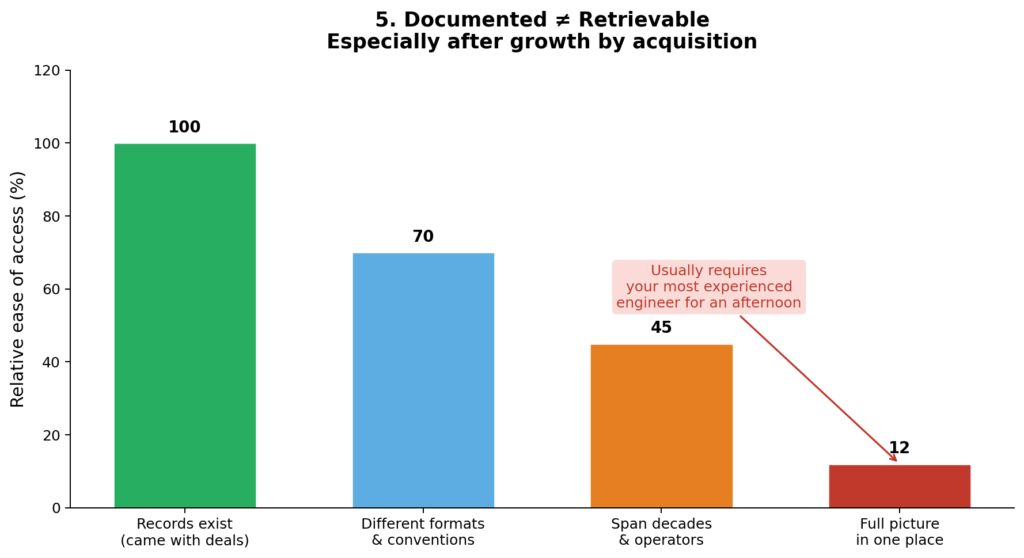
Documented and retrievable aren’t the same thing, and the gap is widest at companies that grew by acquisition.
The records exist — they came across in the deal. They also arrived in different formats, from different operators, organised to different conventions, sometimes spanning decades. So the history is genuinely documented, and pulling a full picture together still means somebody who knows where to look spending an afternoon on it.
That somebody is usually your most experienced engineer. Which works, right up until the week he gives notice.
6. How would we even know if a data load failed?
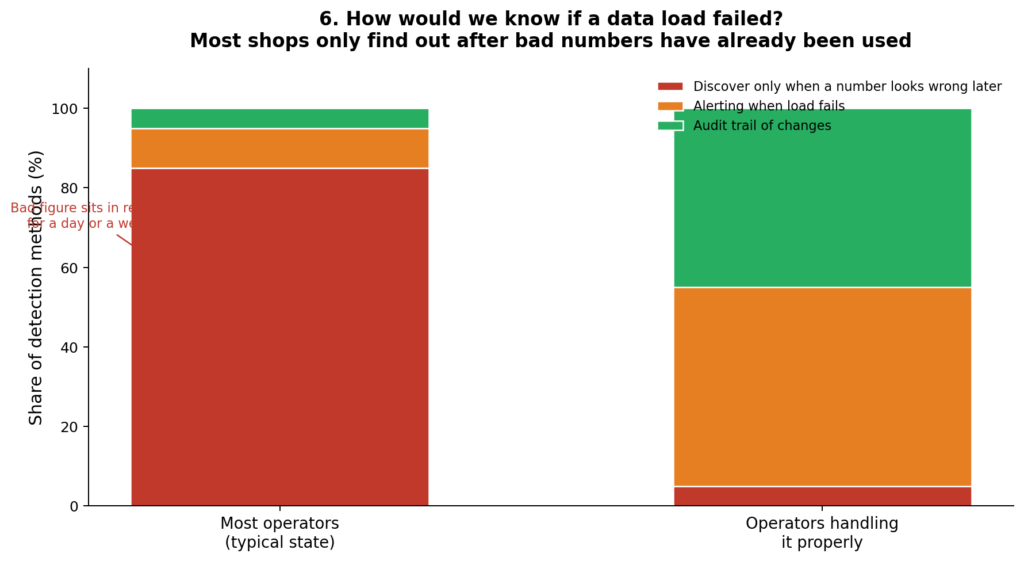
More operators asked a version of this than any other technical question, and it’s the sharpest one on the list.
At most shops, the honest answer is: you don’t. Not until a number looks wrong downstream and somebody works backward to find the cause — by which point the bad figure has been sitting in reports for a day or a week.
The operators handling this properly have two things. Alerting when a load doesn’t complete, and audit trails showing when a record changed and who changed it. If you have both, you’re in better shape than most and it’s worth knowing that. If you have neither, fix it before layering anything on top — because a fast answer built on a silently failed load is worse than a slow one.
7. How long before we see anything useful?
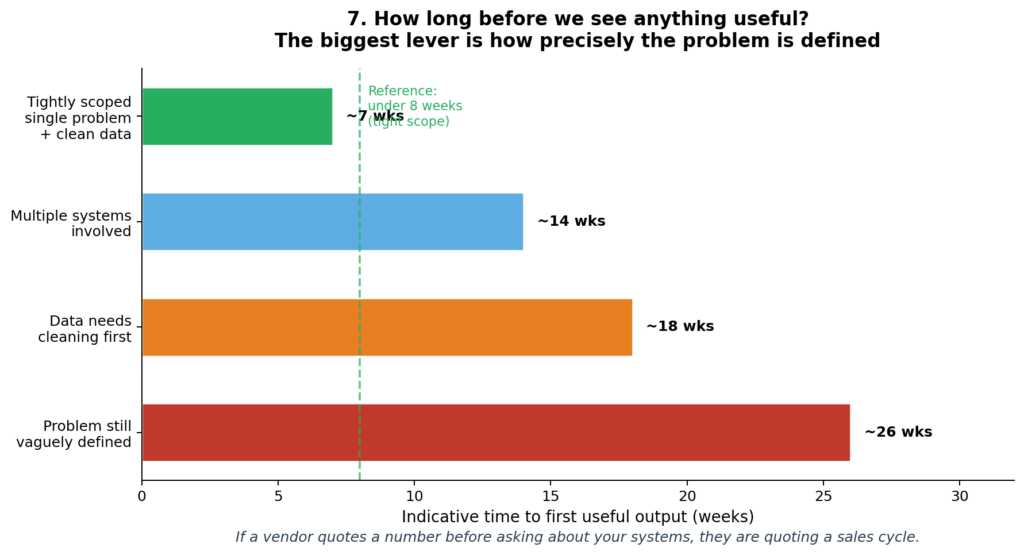
Fair to ask, and fair to be suspicious of anyone who answers it without asking about your systems first.
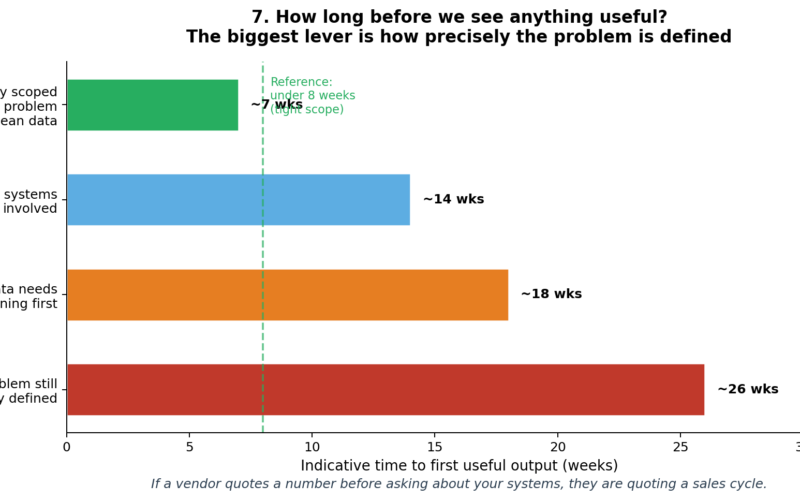
What we can say concretely: the dashboard work we’ve referenced elsewhere took under eight weeks. That’s a real project, not a brochure figure — but it was one problem, tightly scoped, on data already in usable condition. Change any of those three and the number changes.
What actually drives the timeline is how many systems are involved, whether the data needs cleaning first, and how precisely the problem is defined before anyone writes code. The third one matters most and costs nothing to improve.
If a vendor gives you a number before asking about your systems, they’re quoting a sales cycle, not a project.
8. What if we start and it doesn’t work?
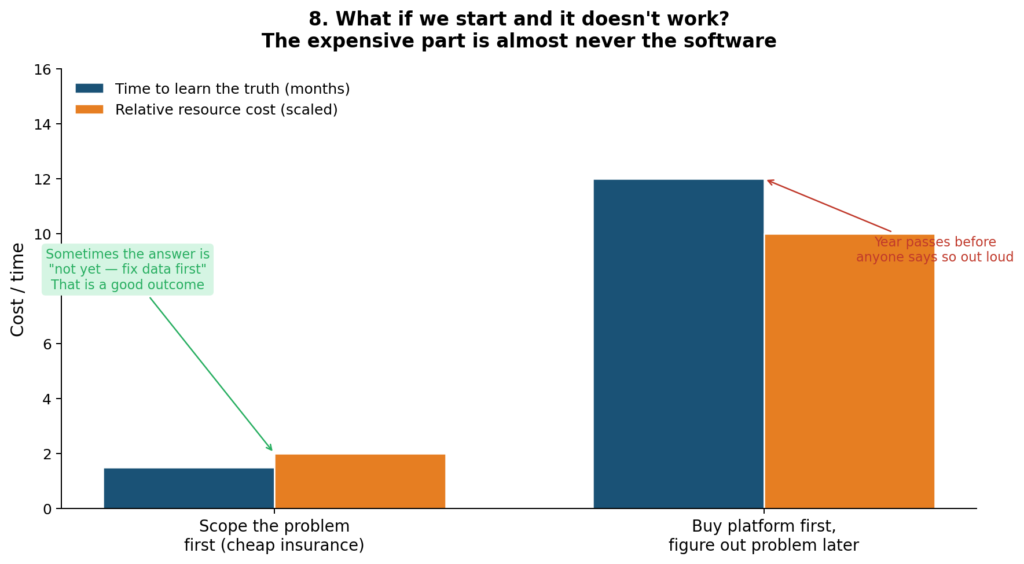
Then the goal is to have found out cheaply.
The failures we see follow one pattern: a platform gets bought before a problem gets scoped, and then the tool takes the blame for a question nobody defined. The expensive part was never the software — it was the year that passed before anyone said so out loud.
Scoping first is the cheap insurance. It sometimes produces the answer “not yet, fix your data first,” and that’s a good outcome. It’s certainly a cheaper one than finding out eighteen months in.
The question underneath all eight AI for operators
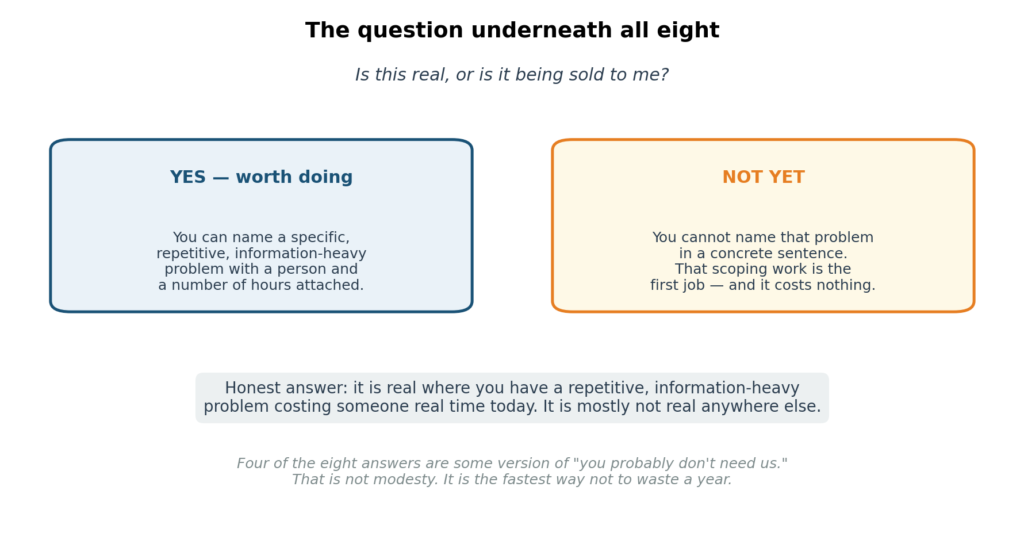
Every one of these is a version of the same question: is this real, or is it being sold to me?
Honest answer — it’s real where you have a repetitive, information-heavy problem costing someone real time today. It’s mostly not real anywhere else, whatever the demo looks like.
So the useful thing isn’t to evaluate vendors. It’s to name that problem, specifically, in a sentence with a person and a number of hours in it. If you can, there’s probably something here worth doing. If you can’t, that’s the work — and it’s work you can do without buying anything.
Contact Us
Ready to find out whether you have a problem worth solving?
Tell us what’s actually slow — who does it, how often, and what happens when it’s late. We’ll tell you honestly whether AI is the right fix, whether something simpler would get you further, or whether you’re not ready yet.
All three are real answers we give.
Find our website here
Office- 832-819-5744
