It’s not the AI. It’s the data.
Most small and mid-sized businesses will spend money on AI tools this year and get almost nothing back. The technology isn’t broken. The data feeding it is.
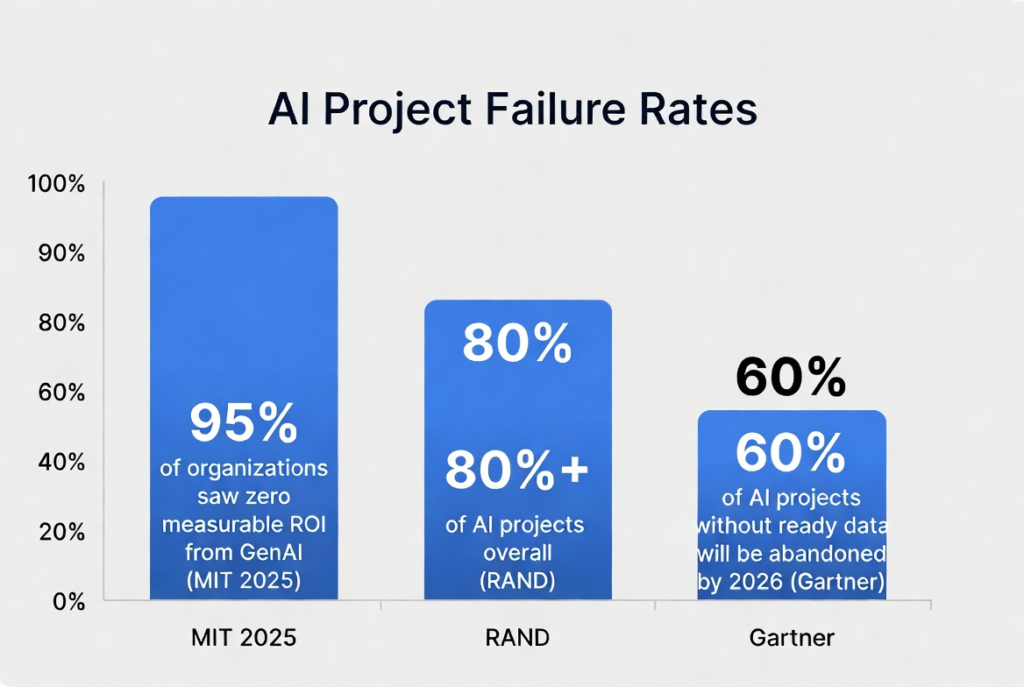
According to a 2024 RAND Corporation study, more than 80% of AI projects fail — twice the failure rate of traditional IT projects. Gartner goes further: through 2026, organizations will abandon 60% of AI projects that aren’t supported by AI-ready data. And in S&P Global’s 2025 survey, 42% of companies abandoned most of their AI initiatives in a single year, up from just 17% the year before.
If you’re an SMB CEO wondering why your Copilot rollout, your AI chatbot, or your “AI-powered” analytics tool hasn’t moved the needle — this is why SMBs fail at AI.
Key takeaway: AI doesn’t fail SMBs. SMBs fail AI by trying to layer it on top of broken data. Fix the data, and AI starts working almost on its own.
TL;DR — The Five-Second Version
- 80%+ of AI projects fail to reach meaningful production (RAND, 2024).
- 63% of organizations don’t have — or aren’t sure they have — the data practices AI requires (Gartner, 2024).
- Poor data quality costs the average organization $12.9 million per year (Gartner).
- The root cause is almost never the model. It’s fragmented data, no ownership, no governance, and no strategy.
- The fix is a 90-day data foundation, not a bigger AI budget.
Why Do Most SMB AI Projects Fail?
After 100+ implementations across SMBs in oil & gas, manufacturing, healthcare, retail energy, and financial services, we see the same five patterns every time. None of them are about the AI.
 AI Project Failure Rates
1. Your data lives in silos
Sales tracks customers in HubSpot. Finance tracks revenue in QuickBooks. Operations runs on spreadsheets. Marketing pulls from a fourth platform. When you ask Copilot for your top five customers by margin, it doesn’t know which version of “customer” to believe.
Real scenario: A 75-person manufacturing company we worked with asked AI for its top customers by profitability. Sales said one list. Finance said another. Operations had a third. Three answers, zero trust, project shelved within 60 days.
Do this week: Make a one-page inventory of every system where “customer” exists. You’ll be shocked at the count.
2. No one owns the data
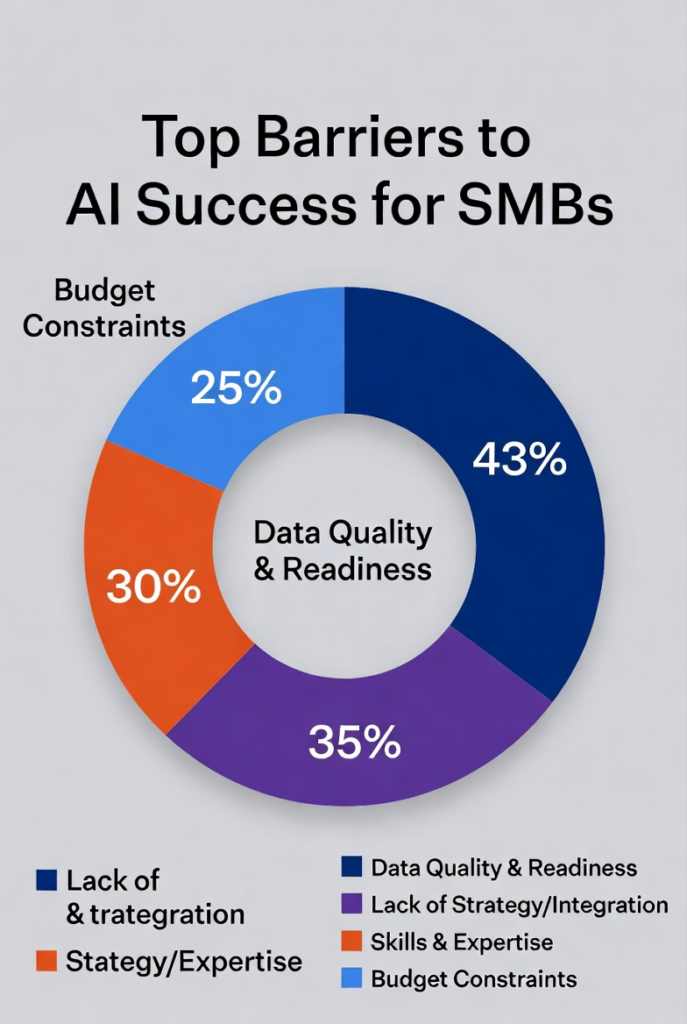
When nobody is responsible for data, quality collapses. Fields go unfilled. Definitions drift. “Active customer” means one thing to Sales (anyone we’ve quoted in 12 months) and something else to Finance (anyone who paid an invoice this quarter). The AI inherits all of it — and amplifies it.
Gartner research found that 63% of organizations either don’t have or aren’t sure they have the right data management practices for AI.
Do this week: Assign one named human as the owner of each core data entity (customer, product, revenue, employee). Not a committee. One person.
3. You have tools, but no strategy
The pattern is familiar: a dashboard from one vendor, a chatbot from another, an automation tool from a third, and now an AI copilot on top. There’s no underlying plan for how data gets collected, cleaned, standardized, or governed. Every new tool is built on quicksand.
This is why MIT’s 2025 Project NANDA study found that 95% of generative AI pilots delivered zero measurable financial return. The pilots worked in demos. They collapsed in production because the data layer underneath them was never designed.
Do this week: Before approving the next tool purchase, write one sentence: “This tool will succeed if [specific data] is clean and [specific person] owns the result.” If you can’t fill in the blanks, don’t buy it yet.
4. Leaders don’t trust the numbers
If your CEO doesn’t believe the monthly revenue report, they will not trust an AI recommendation based on the same source. Without trust in the foundation, AI becomes theater — pretty dashboards no one acts on.
We see this every week. A leadership team will spend $50,000 on an AI initiative and then make the actual decision based on the CFO’s gut, because nobody trusts the underlying numbers enough to bet on them.
Do this week: Pick one number your leadership team argues about. Trace it to its source. Fix that one definition. Trust is built one metric at a time.
5. You’re starting with the wrong question
Most SMB AI efforts begin with “Where can we use AI?” That is the wrong question. It puts technology in front of the problem. The right question is: “What is our biggest operational problem, and could AI actually solve it?”
Technology-first thinking almost always fails. Problem-first thinking almost always works — because it forces you to identify exactly which data needs to be clean, and exactly which person needs to own it.
 Top Barriers to AI Success for SMBs
What Percentage of AI Projects Actually Fail?
The numbers are remarkably consistent across independent research:
| Source | Finding | Year |
|---|---|---|
| RAND Corporation | 80%+ of AI projects fail to reach production | 2024 |
| Gartner | 60% of AI projects will be abandoned through 2026 due to lack of AI-ready data | 2025 |
| Gartner | 63% of organizations lack confidence in their AI data practices | 2024 |
| S&P Global | 42% of companies abandoned most AI initiatives in 2025 (up from 17% in 2024) | 2025 |
| MIT Project NANDA | 95% of generative AI pilots delivered zero measurable financial return | 2025 |
The pattern is impossible to miss: the failure is in the foundation, not the model.
What Is AI-Ready Data?
AI-ready data is data that is consolidated, consistently defined, actively governed, traceable to a single owner, and continuously quality-checked at the source. Traditional data management runs on quarterly audits and monthly reconciliations. AI runs in seconds. The data feeding it has to keep up.
In practice, AI-ready data has five attributes:
- Consolidated — one source of truth per entity (one customer list, not seven).
- Defined — every key term has a written, agreed-on definition.
- Owned — one named person is accountable per data domain.
- Governed — there are rules for how new data enters the system.
- Trusted — leadership uses it to make actual decisions.
If any of those five is missing, your AI will struggle. If three or more are missing, your AI will fail.
Data-Ready vs. Data-Immature SMBs
| Marker | Data-Immature SMB | Data-Ready SMB |
|---|---|---|
| Source of truth | 4–7 systems with conflicting versions | One consolidated warehouse |
| Definitions | “Active customer” means 3+ things | One written definition per term |
| Ownership | “Everyone and no one” | One named owner per domain |
| Reporting cadence | Manual, monthly, late | Automated, daily, on-demand |
| Leadership trust | CEO overrides reports with gut | CEO acts on the dashboard |
| Tool strategy | Buy first, plan later | Define problem, then tool |
| AI outcome | Pilots stall, ROI invisible | Pilots ship, ROI measurable |
If you read down the left column and see your company, you are not behind. You are normal. You are also exactly the SMB that AI vendors are happy to sell to and walk away from.
The 90-Day Data Foundation Roadmap
You don’t need a $500k transformation program. You need 90 focused days.
Days 1–30: Audit and Define
- Inventory every system holding core business data.
- Identify your 5–10 most-used metrics (revenue, customer count, margin, churn, etc.).
- Write a one-sentence definition for each, agreed by all departments.
- Name one owner per metric.
Deliverable: A one-page “data map” the leadership team has signed off on.
Days 31–60: Consolidate and Clean
- Pick one priority domain (usually customer or revenue).
- Pull all sources into a single warehouse (Snowflake, Fabric, or equivalent).
- Reconcile the conflicts. Document the decisions.
- Build one trusted dashboard from the consolidated source.
Deliverable: One executive dashboard that leadership actually uses to make decisions.
Days 61–90: Govern and Apply
- Establish data entry standards and a simple governance cadence (monthly review, quarterly audit).
- Identify one specific business problem AI could now solve with this clean data.
- Run a small, scoped AI pilot against it — with a defined success metric.
Deliverable: One working AI use case with measurable ROI and a foundation that supports the next five.
This is the work that separates the 40% who succeed from the 60% Gartner predicts will abandon their AI projects.
What Should an SMB Do Before Buying AI Tools?
In order:
- Identify the business problem first. Not the technology.
- Verify the data exists. And that it’s not split across five systems.
- Assign ownership. Of the data, the metric, and the outcome.
- Build the dashboard before the AI. If a human can’t trust the report, AI on top of it will be worse, not better.
- Then — and only then — layer in AI.
The boring work is the work. Skip it, and you’ll join the majority who quietly write off their AI investment by year-end.
How CDO Advisors Helps SMBs Get AI-Ready
We’ve run this exact playbook with 100+ SMBs. It’s the foundation behind every successful AI rollout we’ve seen.
- AI Launchpad — our structured program to take SMBs from “AI-curious” to “AI-producing” in 90 days, anchored on data readiness.
- Power BI Quick Start — working dashboards from a clean, consolidated source in as little as 4 weeks, from $10,000.
- Power BI Rescue — for teams whose existing BI is the broken layer underneath the AI ambition.
- BI as a Service — ongoing data stewardship that fixes the “no one owns the data” problem permanently.
- Free Data Assessment — 30 minutes, no commitment, honest answer on where you actually are.
Frequently Asked Questions
Why do most SMB AI initiatives fail?
Most SMB AI initiatives fail because the underlying data is fragmented, inconsistently defined, and unowned. RAND research shows over 80% of AI projects fail to reach production, and Gartner predicts 60% of AI projects will be abandoned through 2026 due to lack of AI-ready data. The model is rarely the problem. The data feeding it is.
What is data readiness for AI?
Data readiness for AI means your data is consolidated into a single source of truth, has consistent definitions, is owned by a named person, is governed by clear standards, and is trusted by leadership. Without these five attributes, AI tools amplify existing data problems instead of solving business problems.
How long does it take to get data ready for AI?
For most SMBs, a focused 90-day program is enough to reach a working baseline: 30 days to audit and define, 30 days to consolidate and clean a priority domain, and 30 days to govern and launch a first AI use case. Larger transformations take longer, but value should start showing inside the first quarter.
How much should an SMB spend on data infrastructure before adopting AI?
SMBs typically spend $10,000 to $75,000 on foundational data work before AI delivers reliable value. Spending on AI tools without that foundation is the single most common cause of wasted AI budgets, and Gartner estimates poor data quality costs the average organization $12.9 million per year in compounded losses.
What’s the difference between AI strategy and data strategy?
AI strategy answers “what problems will we solve with AI?” Data strategy answers “what does our data need to look like for any of that to work?” You cannot execute an AI strategy without a data strategy underneath it. Most SMB AI failures trace back to skipping the second step.
Is AI worth it for small and mid-sized businesses?
Yes — but only after the data foundation is in place. SMBs that solve the data problem first see real ROI from AI in operations, forecasting, and customer insight. SMBs that buy AI tools before fixing the data join the 80% RAND found fail to reach production.
What should an SMB do this week to start?
Pick one metric your leadership team argues about. Identify every system where it lives. Write down its definition. Assign one owner. That single exercise reveals 80% of the work that needs to happen before AI can succeed.
The Bottom Line
The companies winning with AI aren’t the ones with the biggest budgets or the most advanced models. They’re the ones who got their data house in order first.
Stop chasing shiny AI tools. Fix the data. Everything else gets dramatically easier.
Ready to find out where you actually stand?
Book a free 30-minute data assessment. We’ll tell you honestly whether you’re 30 days, 90 days, or a year away from AI-ready — and exactly what to do next.
Book Your Free AssessmentSources cited in this article:
- RAND Corporation, The Root Causes of Failure for Artificial Intelligence Projects (2024).
- Gartner, Lack of AI-Ready Data Puts AI Projects at Risk (February 2025).
- Gartner, Magic Quadrant for Data Quality Solutions (2020, $12.9M figure).
- S&P Global, AI Experience Survey (2025).
- MIT Project NANDA, State of AI in Business 2025.
How we know this: Every observation about SMB AI failure patterns in this article is grounded in CDO Advisors’ direct work across 100+ Power BI and data foundation implementations for SMBs in oil & gas, manufacturing, healthcare, retail energy, and financial services.