
Why Growth-Stage Companies Can’t Trust Their Own Numbers
SMB Data Quality is the hidden crisis in Small Business Decision-Making After auditing dozens of US SMB data setups, we found that the vast majority were making decisions on dirty data.
That reality should alarm you. But what we discovered underneath it should concern
you even more. SMD Data Quality can be a key differentiator for businesses to outperform their competition.
Every growing business hits a wall. Meetings slow down. Decisions get harder. Everyone has data, but no one can agree on what it means. Here’s what that actually looks like — and why it’s more fixable than you think.
There’s a specific kind of frustration that sets in around the time a company hits 20 to 50 employees. Revenue is growing. The team is capable. But somehow, meetings keep getting stuck on the same question: which number is right?
In our work with growth-stage businesses, the advisors at CDO Advisors have seen this pattern repeat across industries, geographies, and company types. The symptoms look different on the surface — one company fights over revenue figures, another drowns in spreadsheet versions, another can’t agree on who’s responsible for data accuracy. But underneath, it’s almost always the same four structural problems. We call them the four patterns of SMB data dysfunction. Understanding them is the first step toward fixing them.
What We Found: The Four Patterns of Data Dysfunction
The “Multiple Truths” Problem
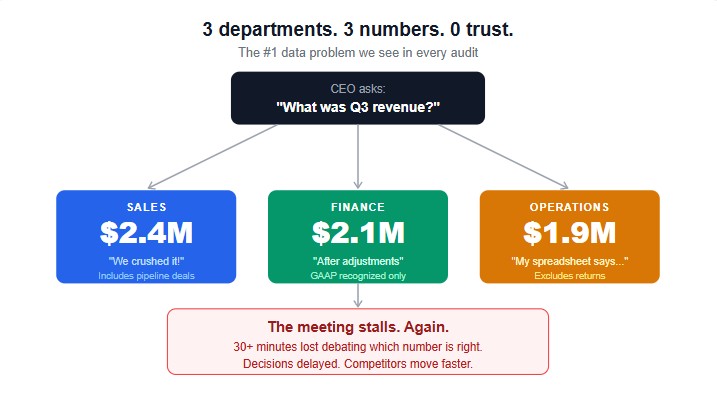
The most common SMB data quality issue we encountered wasn’t missing data—it was conflicting data. Business after business maintained three or more different “versions of truth” for the same KPI.
Sales reports one number. Finance reports another. Operations has their own
spreadsheet that contradicts both. When leadership asks “how did we do last quarter?”,
the answer depends entirely on who you ask. This isn’t a technology problem. It’s an organizational one
The Excel Email Chain
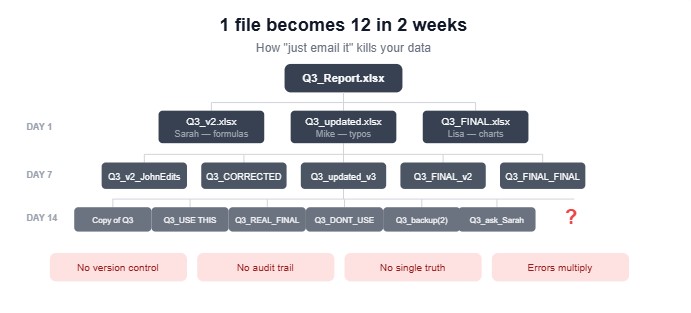
We found entire reporting infrastructures built on Excel spreadsheets being emailed
back and forth as the primary reporting system. The Excel email chain is the hallmark of a team that outgrew its tools but hasn’t replaced them yet. It starts innocently: someone emails a spreadsheet for review. A few people make edits. Someone adds a tab. Someone else renames the file. Two weeks later there are a dozen versions, no one knows which is authoritative, and the person who built the original has moved on to another project.
This isn’t primarily a technology problem — it’s a SMB data quality process problem. And it’s one of the fastest-spreading forms of data decay CDO Advisors encounters. The solution is a centralized data workflow with clear ownership at each stage, not just better file-naming conventions.
Think about what that means:
- No version control
- No audit trail
- No real-time visibility
- Manual copy-paste errors compounding week after week
These aren’t scrappy startups operating on shoestring budgets. These are established
businesses running critical decisions through email attachments.
The Ownership Vacuum
Here’s the pattern that explains almost everything else: no single person owned the
data.
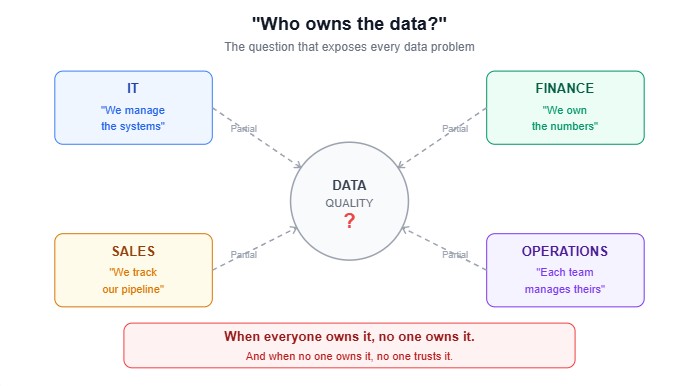
When we asked “who’s responsible for data quality in your organization?”, we heard:
- “IT handles the systems”
- “Finance owns the numbers”
- “Each department manages their own”
- “That’s a good question…”
When everyone owns data, no one owns data. And when no one owns it, no one fully
trusts it.
Ask “who owns the data?” in most SMBs and you’ll get a different answer from every department — if you get an answer at all. IT owns the infrastructure. Finance owns the financials. Sales owns the CRM. Operations owns their own sheets. Everyone is partially right, and that’s exactly the problem.
Shared ownership without explicit accountability creates an Ownership Vacuum. SMB data quality issues fall through the cracks because there’s no single person whose job it is to catch them. The solution CDO Advisors implements is assigning data stewards — named individuals responsible for the accuracy of specific data domains — and making that accountability visible and enforceable across the organization.
The Monday Morning Paralysis
The downstream effect of all this? Leadership teams paralyzed by conflicting
numbers every Monday morning.
We observed executive meetings where the first 30 minutes were spent debating which
dashboard was correct. Strategic discussions derailed by arguments about data
sources. Decisions delayed—or worse, made on gut instinct—because the numbers
couldn’t be trusted.
The cost isn’t just inefficiency. It’s opportunity. It’s confidence. It’s the competitive
advantage that comes from actually knowing your business
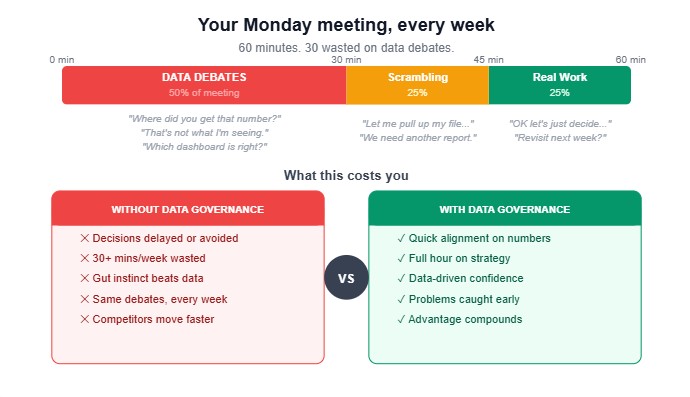
When the first three patterns go unresolved, they surface in the same place: the weekly leadership meeting. Instead of making decisions, the team spends half its time trying to agree on the facts. That’s Monday Morning Paralysis — and once it sets in, it compounds. Leaders start trusting their gut over the data, not because they want to, but because the data has failed them too many times.
The cost is more than wasted meeting time. Every delayed decision is a deferred opportunity. Every SMB data quality debate is a small erosion of the team’s confidence in itself. Companies with strong data foundations move through these meetings in minutes and spend the rest of their time on strategy — that’s a compounding competitive advantage.
“We’ve never met a growth-stage company that didn’t recognize at least two of these four patterns. The good news: none of them require a massive technology investment to fix. They require clarity, structure, and someone who’s done it before. Let’s get your SMB data quality on a path to improvement”
You don’t need an enterprise data team. You need a trusted plan.
The patterns described here are not signs that a company is broken — they’re signs that it’s growing. At some point, the informal systems that worked well for a 10-person team start to crack under the weight of a 30-, 50-, or 100-person organization. That’s normal. The companies that pull ahead are the ones that recognize the symptoms early and put the right foundations in place before the cracks become fractures.
Fixing SMB data quality doesn’t require hiring a full data team or investing in enterprise-grade infrastructure. It requires three things: clear definitions, clear ownership, and a repeatable process for keeping both up to date. Most growth-stage companies can get there in weeks, not months — with the right guidance.
That’s precisely the work CDO Advisors was built for. We bring the experience of seasoned Chief Data Officers to growth-stage businesses that aren’t ready — or don’t need — to hire one full time. We’ve helped companies across industries move from data chaos to data clarity without the overhead of building an in-house function from scratch.
Ready to stop debating numbers and start using them?
If any of these four patterns looked familiar, it’s worth a conversation. CDO Advisors works with growth-stage businesses to build trusted data foundations — the kind that make leadership meetings faster, decisions cleaner, and the entire organization more confident in the direction it’s heading.
Our initial assessments are low-commitment, high-value, and designed to show you exactly where your biggest data risks are hiding and how quickly they can be addressed. No enterprise jargon, no six-figure retainers — just practical expertise applied to your specific situation.
Read More –
SMB Data Why Know One Trusts Your Data
Get Started with a CDO Discovery Workshop
CDO Advisors works with growth-stage businesses to build data foundations that
leadership teams actually trust. If any of this sounds familiar, we should talk